

Revitup.Direct Blog
The real risk for independent hotels in 2026: dependence on OTAs

Cloudbeds' new annual report, “The State of Independent Hotels 2026,” analyzed more than 90 million bookings across tens of thousands of independent properties in 180 countries. The conclusion is clear: 2025 was a year of “divergence” — some destinations gained ground, others lost it, and one of the key reasons was how dependent each hotel remained on online travel agencies (OTAs).
Globally, independent hotels saw average daily rate (ADR) fall 5.8% and RevPAR decline 5.4%, while occupancy stayed relatively stable (-0.6%). At the same time, the share of bookings flowing through OTAs rose to 63.4% in 2025, up from 61.3% in 2024. In plain terms: nearly 2 out of every 3 bookings no longer belong to the hotel — they belong to distribution, with everything that implies for commissions, profit margin, and control over the guest relationship.
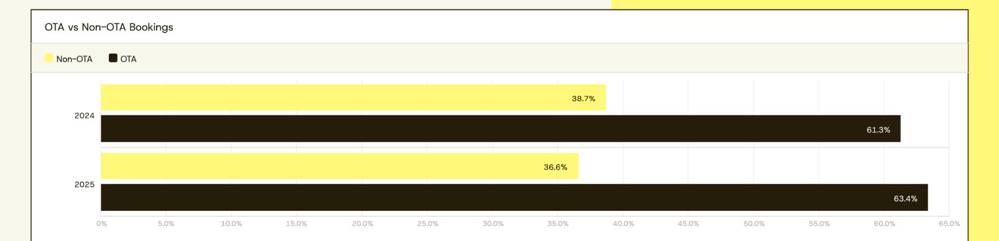
of Independent Hotels 2026
The cost of dependence: cancellations twice as high
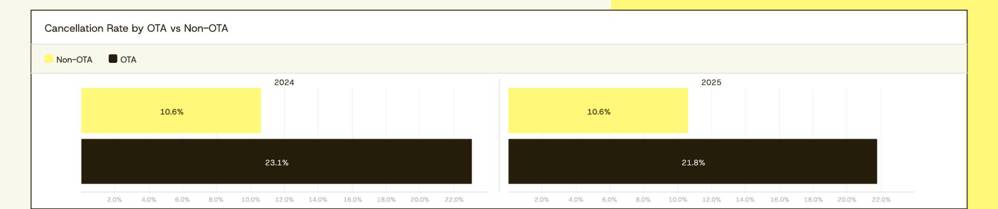
The most interesting — and most concerning — finding concerns cancellations. In 2025, 21.8% of OTA bookings were canceled, compared with just 10.6% of direct bookings. OTA bookings are canceled almost twice as often. That translates into greater revenue volatility, harder forecasting, and a higher risk of unsold rooms at the last minute. A direct booking isn’t just cheaper — it’s also a more “stable” source of revenue.
What the countries competing with Greece show
The report doesn’t look at Greece specifically, but the data for countries that share the same tourism “profile” — Mediterranean, sun-and-sea, independent boutique properties — is instructive.
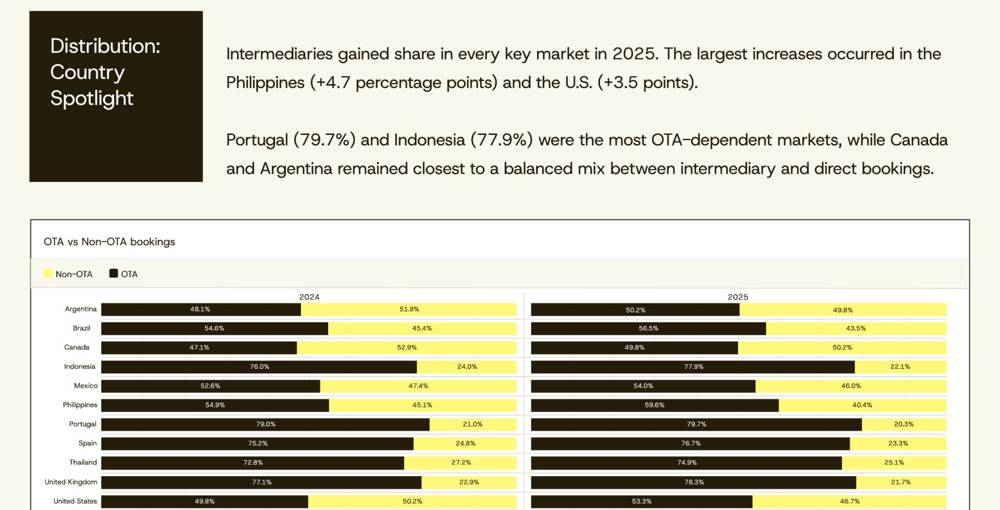
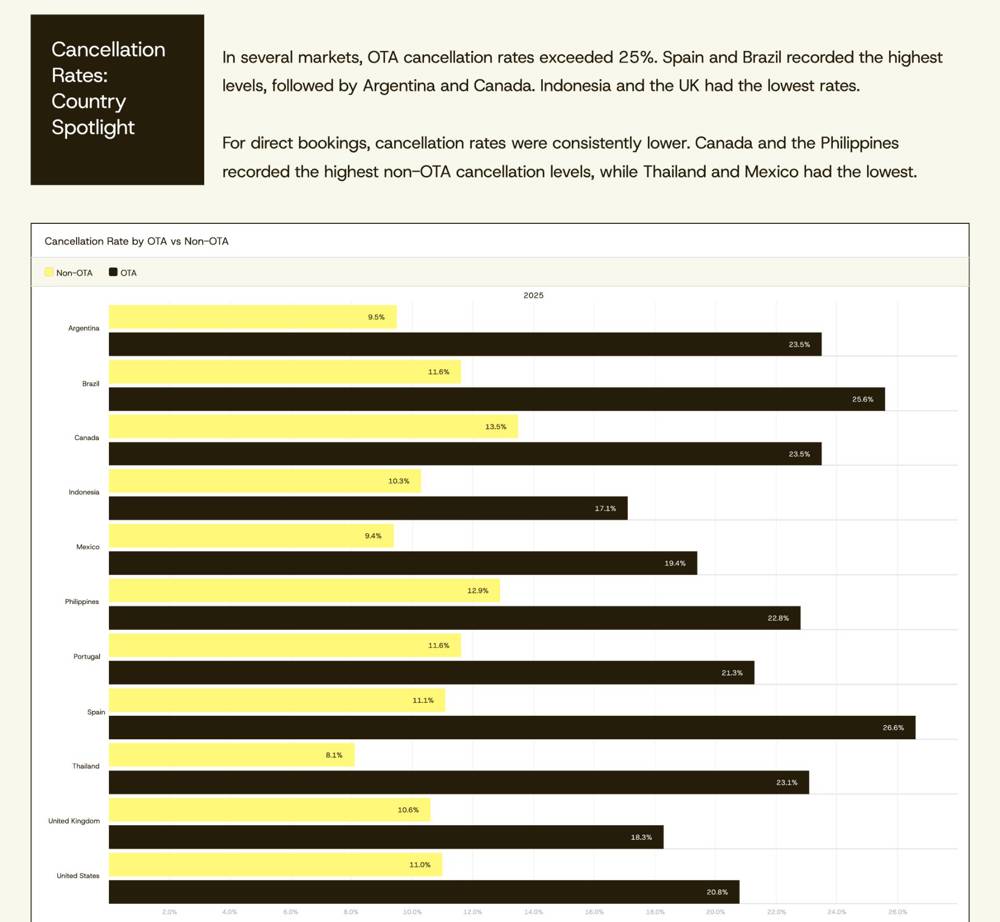
Spain recorded the highest occupancy (63%) among key markets, yet ADR slipped 1% and OTA dependence climbed to 76.7%. Most striking: Spain posted the highest OTA cancellation rate in the entire report, at 26.6% — more than double the equivalent rate for direct bookings (11.1%).
Portugal was the most OTA-dependent market worldwide (79.7% of bookings), and at the same time the only one of the spotlighted countries to post declines across all three key metrics: occupancy -4.3%, ADR -2.9%, RevPAR -6.8%.
Thailand, as a global competing sun-and-beach destination, raised its ADR by an impressive 16.7%, but lost occupancy (-1.7%) — a sign that the market is “normalizing” and that the destination is becoming less price-competitive.
The pattern repeats: the more a destination relies on OTAs, the more volatile its performance becomes — and the less control the hotelier itself retains over the guest relationship, pricing, and customer data.
What this means in practice
The report also shows that travelers are booking their trips earlier (the average “booking window” rose to 40 days worldwide, up from 38 in 2023) but are also canceling earlier when they change their minds. That means a hotel today has more time — if it has the right tools — to communicate directly with the guest before, during, and after their stay, to offer a better rate than the OTAs, and to build a relationship that brings that guest back without paying a commission. An up-to-date website with online booking, a “best rate guarantee” policy for guests who book direct, and simple, automated communication before and after the trip are often enough to tip the balance of power back toward the hotel.
The lesson for Greek independent hotels
Greece competes directly with these same destinations for the same traveler. If Spain and Portugal, with far larger marketing budgets and stronger national brands, are struggling with the same dependence on distribution, then the risk for a small or mid-sized Greek hotel is even greater if it doesn’t invest early in its own direct booking channel.
That’s exactly why our name says it plainly: revitup.direct. We believe a direct booking isn’t just another way to sell rooms — it’s the foundation for steadier revenue, a lower cancellation rate, lower commission costs, and, most importantly, a guest relationship that belongs to the hotel, not to a middleman.
In a market where, as Cloudbeds’ research also shows, uniting strategy, systems, and team becomes the real competitive advantage, strengthening the direct channel isn’t a luxury. It’s a prerequisite for an independent hotel to stay independent.