

Revitup.Direct Blog
AI in Hotel Marketing: What's Real and What's Noise
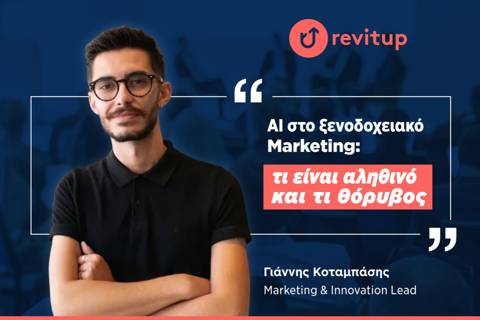
An interview with Yannis Kotampasis, Marketing & Innovation Lead at RevitUp.Direct
AI has become the most-talked-about word in marketing — and with it, the noise. Ahead of the 6th Revenue Masterclass, we spoke with Yannis Kotampasis about where artificial intelligence adds real value to a hotel's digital marketing, and where we're simply following the trend.
AI has become the most-talked-about word in marketing. Where does it genuinely earn its place inside a hotel, and where are we just following the trend?
The biggest source of noise is that many people treat AI as a destination. As if "adding AI" were a goal in itself. It isn't. It's a point of integration — it goes inside a process you already run, to make it better.
So the right question isn't "where do I use AI?", but "in which parts of my work does it genuinely add something?". And there, for a hotel, I see three clear points. The first is speeding up processes that eat time. The second, cutting costs on jobs that until now required more hands or more hours. And the third, which I find the most interesting, is data analysis: delegating to AI the work of drawing conclusions about your audience and its behaviour — something a small organisation rarely has time to do seriously by hand.
Seen that way, the noise falls away on its own. You stop caring what AI can theoretically do; you care what it solves for you, today, in your own work.
But the tools existed two or three years ago too. Why is the subject more relevant now?
I'll tell you something that sounds contradictory: nothing changed and everything changed.
Technology keeps evolving — that's not news. The real issue is that the people who use it have to evolve along with it. And that's where the gap opens up. The traveller's expectations are higher today, competition is fiercer, and every detail counts more than ever. In that environment, using AI properly isn't a luxury — it's where the difference is made.
In other words, the point isn't that "a new tool came out". It's that the level at which you have to work in order to stand out has risen — and AI is what lets you keep up without tenfolding your team.
I'll give a very simple example, more for the sake of discussion than as something impressive. You take data and figures from your bookings, feed them to the AI and ask it to build specific customer profiles, guest personas: who really books with you, what traits they share, how they behave.
It's neither difficult nor groundbreaking. But it's revealing more often than you'd expect. Most hoteliers are convinced they know their audience — and in practice, when they see it in black and white through their own data, they're almost always surprised. Something they took for granted turns out to be wrong, or an audience appears that wasn't even on their radar.
The point isn't the tool. It's that you stop deciding based on what you think, and start deciding based on what the data shows.
There's a fear that, with AI, everyone will end up sounding the same. Where's the line?
The fear is valid, but the cause isn't the tool; it's how one uses it. AI is a tool. We choose how, where and when we'll use it, we choose what we'll automate, and we choose what actually goes out.
If you ask it for something generic, it'll give you something generic — and yes, you'll sound like everyone else. But if you first give it the identity of the property, its character and the way it communicates, and set it to work on your own specific issues rather than on generalities, then the result carries your own fingerprint.
And here I want to be precise, because it's often said wrong: AI doesn't think for us. It gives us speed, scale and lower cost. The judgement — what's right to say and how — we keep for ourselves. The moment we forget that, we really do start to sound all the same.
And in direct communication with the customer? Where does it help, and where should it stop?
It helps with whatever can be anticipated and set up in advance: availability questions, frequently asked questions, simple and repetitive matters you can organise correctly once. There, an instant answer at eleven at night is real service.
But there's a rule I don't break: there must always be the option to connect with a human. Especially on service matters or more immediate, personal issues, the customer shouldn't feel trapped in an automated system.
And that's the line, for me: AI goes in there for the customer's own convenience, not to get an obligation off the hotel's back. When the customer feels the first, they appreciate it. When they realise the second, they remember it — for the wrong reason. That's why there's no contradiction: you don't hand the relationship with the customer over to a tool; you put the tool in charge of the easy and the repetitive, and you keep the human for whatever genuinely needs a human.
On 16 October, at the 6th Revenue Masterclass, AI has a prominent place in the programme. What do you want the hotelier to walk away having understood?
I'd like them to leave with one conviction: that AI is neither a magic wand nor a threat. It's a tool that pays off only when you use it with strategy and for a specific purpose.
It's no coincidence that the subject has a distinct place this year. Professor Dimitrios Buhalis talks about profitability in the era of artificial intelligence, through the use of data and personalisation — which is exactly what we discussed: genuinely understanding your audience and speaking to it correctly. And there's the talk "From enthusiasm to failure: why Artificial Intelligence needs strategy", which puts it most clearly: without a plan, the technology alone isn't enough.
If the hotelier keeps one thing, I'd want it to be this: don't start from the tool, start from what you want to achieve. AI will get you there faster and cheaper — but the destination is yours to set.
Want AI in your marketing done with strategy, not as a trend?
This is exactly what we'll explore in depth at the 6th Revenue Masterclass, on 16 October in Heraklion. Register for free here: register for free here · Or talk to our team.