

Revitup.Direct Blog
The Cost Behind Every Booking: Which Channel Really Pays Off?
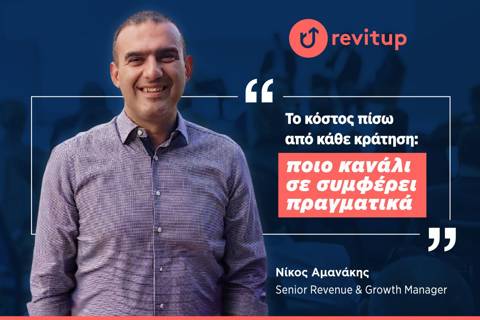
An interview with Nikos Amanakis, Senior Revenue & Growth Manager at RevitUp.Direct
In hospitality, increasing bookings remains a core goal. Yet real growth doesn't depend only on total sales volume, but on how organised, coordinated and efficient a hotel is in managing all of its available channels.
Direct bookings, OTAs, B2B partnerships, digital advertising, pricing, distribution and revenue management can't operate as separate units. They need a shared strategy, unified data and continuous evaluation.
We talk with Nikos Amanakis about the real cost behind every booking and how a holistic approach to sales can help a hotel strengthen not only its revenue but its overall profitability.
Nikos, when we talk about the "cost of a booking", what exactly do we mean?
The first thing to clarify is that the amount we see on a booking isn't necessarily the real revenue that stays with the hotel.
Every channel has a different cost. On OTAs there may be commission; on a direct booking, advertising cost, loyalty discount, booking engine or payment fees; while in B2B the cost may be built into the net rate or the commercial agreement.
For that reason, proper evaluation isn't done at Gross Revenue level alone. What matters is knowing what each booking ultimately leaves with the hotel.
So is it enough to compare which channel has the lowest commission?
No, and this is one of the key points where a more organised approach is needed.
If we look at a channel in isolation, we can reach the wrong conclusions. For example, an OTA may have a higher cost but open access to a market where the hotel has no strong direct presence. Likewise, direct can have a lower cost in one period and a higher one in another, depending on media spend and demand.
So the aim isn't to find the "cheapest" channel. It's to understand the role each channel plays within the overall commercial strategy.
Does that mean Revenue, Marketing and Sales can't operate independently?
Exactly.
Today, a hotel's performance can't be optimised when each department looks only at its own metrics.
Revenue may adjust prices, Marketing may increase traffic and direct bookings, Sales may develop B2B partnerships and Distribution may manage the channels. But if these actions aren't connected to one another, conflicting strategies can emerge.
The essence lies in coordination.
We need to know what demand exists, where it comes from, at what cost, at what price it converts into a booking, and what its net value ultimately is.
How does this holistic approach translate in practice?
It takes, first of all, a shared view of the data.
It's not enough to track occupancy, ADR, ROAS or an OTA's production separately. We need to connect them.
For example, when we examine a low-demand period, we have to look at the same time at which channels are producing, which markets show demand, what the acquisition cost is, what the cancellation rate is, what the length of stay is, what pricing is applied, which offers are active, how much traffic we're bringing to the website, how effectively that traffic converts into direct bookings, and how much Net Revenue each source ultimately leaves.
Only then can we make a truly commercial decision, rather than a fragmented one based on a single metric.
What's the role of the direct channel within this strategy?
The direct channel is pivotal, because it lets the hotel build a stronger relationship with the guest, keep better control of its commercial offer and gradually increase its independence from third-party channels.
The goal, though, isn't simply to raise the share of direct bookings. It's to strengthen bookings through the property's website in a sustainable way.
That means we have to look at the whole user journey: from how they'll reach the website, to whether they'll find the right price, the right offer, an easy-to-use booking engine and the reasons that will convince them to complete the booking directly.
Consequently, growing direct bookings isn't only an advertising matter. It connects to revenue strategy, pricing, rate parity, loyalty benefits, website experience, remarketing, metasearch and, overall, to how competitive the official website is as a sales channel.
So growing direct bookings isn't only a Marketing goal?
No. It's a shared commercial goal.
Marketing can bring the right user to the website, but if the price isn't competitive, if availability isn't right or if the offer hasn't been designed properly, the booking may end up on another channel.
Likewise, Revenue can create the right pricing strategy, but without proper promotion and distribution, that strategy won't reach the right audience.
That's why strengthening the direct channel requires cooperation between Revenue, Marketing, Sales and Distribution.
And what role do OTAs and B2B partnerships play?
Both can have strategic value.
OTAs can offer visibility, access to new markets and high demand in specific booking windows.
B2B channels, on the other hand, can offer stability, volume or access to markets where the hotel wants to grow.
The aim isn't to replace one channel with the other, nor to pursue a full shift of sales to direct.
The right strategy is to use each channel for the role it can play best, while creating the conditions for a larger part of the demand that already exists for the hotel to convert into a direct booking.
Is there an ideal channel mix?
No, because every hotel has different needs.
The ideal mix depends on the product, the destination, seasonality, the markets, the positioning and the commercial goals.
What's more, the channel mix shouldn't stay fixed throughout the year.
In a high-demand period there may be more room to strengthen the direct channel and limit certain promotions or high-cost channels, while in a shoulder period a different allocation may be needed.
That's why it takes continuous monitoring and adjustment.
What does an "organised commercial strategy" mean for a hotel?
It means decisions aren't made in a fragmented way.
There are clear goals, regular monitoring of results and a common direction across Revenue, Sales, Marketing and Distribution.
If, for example, low demand is observed in a specific period, the solution isn't necessarily just to raise the advertising budget or give a bigger discount.
The whole picture has to be examined: price, availability, markets, channels, booking window, competition, website performance and demand behaviour so far.
That's the difference between simply managing bookings and a genuinely integrated commercial strategy.
How does RevitUp approach this process?
Our thinking is based on the idea that Revenue Management, sales, Marketing and Distribution are pieces of the same picture.
That's why we try to keep a single, unified approach: gathering the data, analysing it in combination, and turning the insights into specific commercial actions.
One of our core goals is also strengthening the direct channel. But this isn't treated in isolation as a digital-marketing objective. It connects to pricing policy, offers, availability, presence on the other channels, the booking engine, conversion and, overall, the hotel's commercial position.
We don't only care about increasing bookings from a single channel. We care about understanding how each action affects the overall revenue mix, the acquisition cost and, ultimately, the hotel's profitability.
That takes continuous communication between teams, structured monitoring and the ability to adjust the strategy as market conditions change.
If a hotelier were to keep one key message from this conversation, what would it be?
That there's no single channel that, on its own, will solve a hotel's commercial problem.
Real performance comes when there's planning, organisation and an overall view of sales.
The goal is to use every channel well, while at the same time building a strong direct strategy that leads more visitors to book directly with the hotel.
What matters isn't only how many bookings each channel brings, but what real value it creates, how it connects with the other channels and how it contributes to the hotel's overall goals.
That's what ultimately lets a hotel business move from managing bookings to the strategic management of demand, sales and revenue.
Do you see what each of your channels really leaves behind?
These are exactly the decisions — how channels, data and technology turn into real profitability — that we'll analyse at the 6th Revenue Masterclass, on 16 October in Heraklion. Register for free here · Or talk to our team.